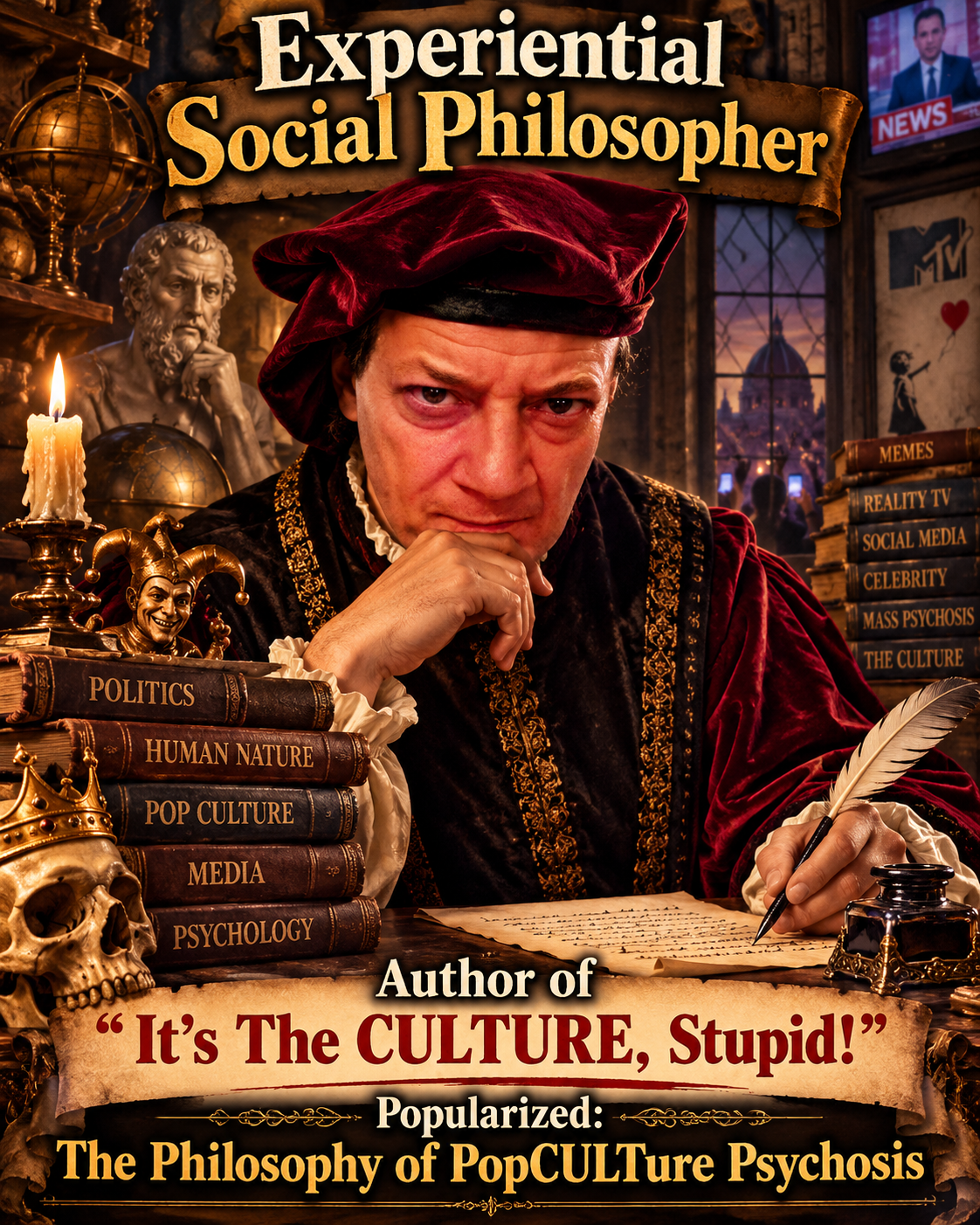
THE CURRENT OF POP CULTURE PSYCHOSIS
An Experiential Social Philosophy
TONY VENUTI
Manuscript edition - September 2026
Jimi asked: Are You Experienced? Tony asks: Are You Popularized?
AUTHOR'S NOTE
This is not primarily the story of Tony Venuti's life. Tony's life gets called as a witness.
I am writing as what I have come to call an experiential social philosopher. I did not arrive here through a university department. I arrived through family, poverty, Vietnam, addiction, crime, prison, sales, publishing, radio, picket lines, business, failure, recovery, observation and a lifetime habit of asking why people do what they do.
That does not make me automatically right. It does explain where the intuit comes from.
A little biography matters because a reader has every right to ask: Who the hell is this guy, and how in the world did he come to believe he KNOWS any of this? The answer is not a diploma. The answer is experience examined after the fact - sometimes correctly, sometimes not.
My life is evidence of formation, not the plot. Ma appears because she gave me a measuring stick. Prison appears because it taught me how rationalization, leverage, fear, identity and time feel from the inside. Sales and publishing appear because they taught me attention, persuasion and perception. Picketing appears because eventually the talker had to walk.
And yes, Tony can sound like a man who thinks he knows everything. That is why the method has to contain its own brake.
Throughout the book I use five labels because certainty and proof are not the same thing:
I KNOW - personal experience.
I OBSERVED - something I witnessed.
I THINK I KNOW - intuition, inference, logic or deduction.
I BELIEVE - a conviction or judgment I cannot establish as fact.
THE RECORD SHOWS - something documented outside Tony's head.
The point is not to make Tony timid. The point is to let Tony run - while telling the reader exactly how far the evidence has run with him.
TONY + CHAT
CHAT is the counterpoint in this edition. CHAT does not get a veto over Tony's intuit. CHAT's job is to mark the boundary between an idea that deserves examination and a conclusion that has earned the word proven.
When Tony leaps, CHAT asks what the leap is standing on. When the record contradicts Tony, CHAT says so. When later evidence strengthens something Tony sensed earlier, CHAT records the discovery. The old thought is not quietly erased; the reader gets to see what changed.
CHAT - METHOD
A strong intuition can be a good reason to investigate. It is not, by itself, evidence that the intuition is true.
TONY - RESPONSE
Good. Don't amputate the intuit. Put a leash on the certainty.
One more clarification: 'Pop Culture Psychosis' is provocation, not a clinical diagnosis. I am using psychosis rhetorically to describe a culture capable of becoming detached from what I regard as obvious reality. The book does not diagnose a population.
CONTENTS
PROLOGUE Are You Popularized?
PART I THE EXAMINER
1 Why Are People the Way They Are?
2 The Presumptive Philosopher
3 How Do You Know When You KNOW?
4 I AM ME
PART II THE CURRENT
5 Are You Popularized?
6 Media-Ocracy
7 The Trick Bag
8 The Trump Phenomenon
PART III THE MEASURE
9 In Search of IS
10 OF THE CENTER
11 Responsibility
12 Manifest Destiny II
EPILOGUE The Book Lived
NOTES Selected Record Notes
PROLOGUE
ARE YOU POPULARIZED?
Jimi Hendrix asked, Are You Experienced?
Tony asks a different question:
ARE YOU POPULARIZED?
Not popular. Popularized.
Popular is what happens when a lot of people like you. Popularized is what can happen when the culture gets inside you before you notice it was invited.
A phrase becomes normal. A lifestyle becomes cool. A villain becomes heroic. A responsibility becomes old-fashioned. A political position becomes part of an identity. A celebrity supplies the attitude. A tribe supplies the explanation. Pretty soon the borrowed opinion feels home-grown.
Did I THINK this - or did I JOIN it?
That question is not aimed only at the Left, the Right, MAGA, academia, Hollywood, religion, corporations or the kid staring at a phone. It has to reach Tony Venuti or it is useless.
This book is my attempt to follow that current without pretending I am standing on the shore.
I am in the water too.
PART I - THE EXAMINER
CHAPTER 1
WHY ARE PEOPLE THE WAY THEY ARE?
I have spent a good portion of my life trying to figure people out. Not because I am a psychologist. I am not.
I am a Presumptive Philosopher.
There is a difference.
The question underneath much of my writing was never simply, Why did Tony become Tony? The larger question was: Why are people the way they are?
Why can two people look at the same thing and see different realities?
Why do people follow?
Why do they conform?
Why do they make things RIGHT in their own heads?
Why can an intelligent person behave stupidly?
Why can a person know better and still do worse?
My own life became useful because I was not outside the human condition taking notes. I was one of the specimens. I have been wrong for reasons that made complete sense to me at the time. That is valuable information if you are willing to admit it.
One of the habits I developed was putting myself in the other man's shoes. Not the easy version where I imagine what I would do if I were him. I mean trying to think as he would think. What would have to be true inside his head for what he is doing to make sense to him?
I have another way of saying the same thing: do not talk to me about my feet until you have been in my shoes. You can study my shoes. You can measure my walk. You can watch where I went. But do not tell me what my feet feel like.
That is not an argument against evidence from the outside. It is an argument for knowing what kind of knowledge you have. Lived experience gives access to something observation cannot fully duplicate. Observation can still correct the person doing the living. Both matter.
Experience also creates its own danger. The same dark-side experience that taught me to read fear, leverage, motive and deception can make me expect them where they are not. Experience can sharpen intuition. It can also bias it. So I have to ask myself: is my experience warning me - or prejudicing me?
CHAT - COUNTERPOINT
Lived experience can reveal patterns and sharpen questions. It cannot establish what is inside another person's head without additional evidence.
TONY - RESPONSE
Agreed. Experience gets me to the door. It does not let me claim I was inside the room.
That is a different exercise.
It also became part of the way I talked to people. Before criticizing someone I can often hear a quick internal question: put me in his shoes. How will this land? Is it offensive? If it is offensive, is the offense doing useful work or merely destroying the point?
Sometimes the answer is don't say it.
Sometimes the answer is say it.
I have never been especially frightened of irritating somebody. But irritation is not automatically intelligence. The useful provocation is the one that gets close enough to insult that the reader thinks, Is this son of a bitch insulting me? - and while deciding, considers the question.
That is what sits underneath "Aren't I embarrassing you?"
The deeper Tony version is probably this: If I GET it, why don't YOU?
That can sound arrogant until you understand what I mean by "I." I am not presenting myself as the university professor standing at the front of the room. I am the guy who spent years addicted, committed crimes, went to prison, blew opportunities, rebuilt, lost things, rebuilt again and learned mostly by having consequences hit him in the face.
I am your lowest possible bar.
If I could get here from where I started, what is your excuse?
That is the provocation.
It is also where I have to watch myself. A person can turn his own survival into a weapon against somebody whose burden he does not understand. My experience gives me perspective. It does not give me omniscience.
Need gets patience. Excuses get impatience.
The problem is that Tony has to decide which is which.
And Tony has been wrong before.
Put that in bold type.
There is something underneath a lot of what people have called my anger over the years. Anger is not my philosophy. Anger is sometimes the ignition.
Fear can be ignition too.
We are taught to think of fear as weakness, but fear often precedes action when the action required is uncomfortable. The question is whether the fear moves you toward thought or away from it. Same with anger. Anger can focus the mind, or it can burn the damn house down before you remember you live there.
Grievance can do the same thing. A real wrong can produce real resentment, and resentment can produce a legitimate demand for redress. But grievance can also become a reason to stop assessing and start collecting evidence for revenge. An axe to grind makes a lousy measuring stick.
The book should not turn ANGRY Tony into the main character. He existed. He still shows up. But the more important Tony is the watcher.
I watched people.
I watched myself.
I watched the gap between what people said and what they did.
I watched groups make people braver and dumber at the same time.
I watched belonging become a substitute for thinking.
That is where POPULARIZED becomes a people problem, not merely a media problem. Belonging feels good. Exclusion hurts. Once the price of admission to a group is agreement, your opinion can become the membership fee.
The self-check I wish I had asked more often is brutally simple: Did I THINK this - or did I JOIN it? The question has to work on liberals, conservatives, MAGA, academia, religion, corporations, families, social circles and Tony Venuti. If it only works on the other side, it is not a measuring stick. It is a weapon.
I watched people borrow identity from crowds.
That led me to an idea that connects directly back to I AM ME.
There is identity that comes from inside, and identity that has to be fed from outside.
The second kind is hungry.
It wants approval. It wants the IN Crowd. It wants celebrity, movement, tribe, ideology, applause. It can make a person defend something he would never have invented on his own because rejecting the belief now feels like rejecting himself.
That is one reason culture interests me as much as politics. Politics is usually the visible argument. Culture is the water the argument is swimming in.
Try telling a fish it is wet.
The fish has no clue.
The same question has to be asked of me: Which water was Tony swimming in without knowing he was wet?
That is a much better question than simply telling everybody else they are programmed.
I have written about the Human Condition versus the re-Conditioned Human. The mature version of that idea cannot be that everything I like is "natural" and everything I dislike is "re-conditioned." That would be too easy.
The useful question is: How much of what I called nature was nature - and how much was the world that raised me?
Family. Sex. Work. Masculinity. Femininity. Race. Religion. Ambition. Duty. Shame. Pride. Patriotism. Success. Failure. All of these are shaped by some mixture of biology, circumstance, family, institutions, culture and personal choice.
I do not have a formula that separates them perfectly.
What if there were no hypotheticals?
Sorry. Couldn't resist.
But adulthood is one area where my patience has remained pretty consistent. Childhood deserves protection. Adulthood demands responsibility.
That does not mean adults never need help. Of course they do. I have needed help. Everybody does. It means help should not become an argument against agency where agency still exists.
What happens to a society when it becomes increasingly difficult to tell where childhood ends and adulthood begins?
What happens when culture itself encourages the adult not to grow up?
Who benefits from people who never quite become the boss of themselves?
Those are people questions before they are political questions.
Which brings us back to the laboratory.
People are not merely what they say they believe. They are what they fear, need, want, protect, imitate, excuse, envy, remember, forget and make RIGHT in their heads.
And if the book has a laboratory, that is it.
Including the specimen writing the book.
CHAPTER 2
THE PRESUMPTIVE PHILOSOPHER
I work in the presumptive. I know what I know, and more importantly, I know what I do not know. I trust my intuit, then allow logic, reason, deduction and experience to work on the idea.
That sentence appeared in my writing long before we started organizing this book, which matters to me because it tells me I was not inventing the philosophy afterward to make the life look prettier.
Presumption is not certainty.
It is permission to begin.
My mind has always been willing to run ahead of the evidence. I allow it. I put myself in another person's head. I follow the logical progression. I ask what happens if the premise is true. I connect things. I make a presumption. I give it the smell test. If it survives that, I let it swim upstream.
Sometimes it makes it.
Sometimes it dies somewhere along the river.
Theory of Duh.
Not every thought that comes out of Tony Venuti deserves to be bronzed.
The discipline comes after the idea appears.
I once wrote a version of it this way: your intuitive alerts your BRAIN; your BRAIN must confirm.
That matters. Intuition is not a certificate of truth. Intuition notices. Reason examines. Experience tests. Evidence confirms - or doesn't. Certainty comes last.
Logic can take me somewhere evidence hasn't reached yet. That doesn't mean I get to call the destination KNOW.
Inference is allowed to travel ahead.
Certainty has to wait for evidence.
CHAT - COUNTERPOINT
Tony's method works best when intuition is treated as a hypothesis generator. Logic can test internal consistency; evidence determines how strongly the conclusion should be stated.
TONY - RESPONSE
Exactly. Inference is allowed to travel ahead. Certainty has to wait for the evidence.
That is why "How do you know when you KNOW?" became so important. The dangerous man is not always the ignorant man. Ignorance can be corrected. The dangerous condition is not knowing that you do not know and manufacturing an answer anyway.
I once reduced the problem to a provocation: if you think you know, you don't know. Crude? Sure. But the point was serious. There is what I know through direct experience. There is what I observed. There is what I think I know through reasoning. There is what I believe. And there is what the record can actually show.
Those are not interchangeable categories.
There is another distinction that now belongs beside those categories: Tony does not judge. Tony assesses. That is not me pretending to have no values. It is a method. Input -> output. Action -> reaction. Cause -> effect. Effort -> result. Claim -> evidence. Then decide what the math actually says.
Do not judge the label. Assess what is inside it. Define it first. Then assess it. If everything is something, when is it NOT something? A category with no boundary does not tell you much.
So the book uses them deliberately:
I KNOW - personal experience.
I OBSERVED - something I witnessed.
I THINK I KNOW - inference, intuition, logic, deduction.
I BELIEVE - a conclusion or conviction I cannot establish as fact.
THE RECORD SHOWS - something that can be documented outside Tony's head.
That system is not there to make the prose academic. It is there to keep confidence from impersonating evidence.
The Power of Certainty begins there.
Certainty is not pretending to know everything. False certainty is nearly the opposite. Real certainty includes being able to say, "I don't know."
I KNOW what I know.
I DON'T KNOW what I don't know.
And I'm not going to manufacture an answer because somebody expects one.
There is another part that took longer to articulate. I do not need the last word WHEN the Power of Certainty has been presented.
The "when" matters.
If I have simply barked an opinion, that is not certainty. If I have explained what I know, what I observed, what I inferred, where the evidence ends and where my judgment begins, then your refusal to agree does not make the explanation disappear.
You can agree, disagree, laugh or prove me wrong.
If you prove me wrong, then I have something new to know.
The more I examined my old writing, the more I saw another danger. Certainty can explain persuasion; it cannot establish truth.
The Power of Certainty therefore has to meet performance. Certainty without action is confidence. Action without evidence is motion. Credibility begins when the claim survives the result. Promise -> performance -> proof -> assessment.
Do not tell me what you believe. Show me what your belief produces.
That became especially important in my writing about Trump. I responded strongly to what I perceived as certainty and authenticity. I believed he believed what he was saying. That is psychologically important. It may explain why an audience trusts a person.
But it does not make the person correct.
Was I responding to what Trump said - or to the fact that I believed HE believed what he said?
Fine. He believes it.
Now the Presumptive Philosopher has to ask the harder question:
Is he RIGHT?
That self-audit changes the whole book.
Definitions matter because language is the toolbox of thought. Before you build an argument, check the damn tools. Before you measure anything, make sure somebody has not bent the ruler.
A word has a definition, a context and a history. Change the meaning and you can change the argument without announcing that the argument changed. Sometimes language changes organically. Sometimes people deliberately stretch it. I do not get to presume motive. I do get to inspect the ruler.
That is why the half-full, half-empty argument amuses me. Before you two idiots finish arguing, maybe somebody ought to ask what is in the glass. Fact first. Frame second. Assessment before allegiance.
It also explains why I found an old critical-thinking framework so interesting. In 2016 I circulated a Paul and Elder framework for evaluating thinking: purpose, assumptions, point of view, information, inference, implications, accuracy, relevance, breadth, fairness and more. I was using it to ask what standards journalists should meet.
Years later the obvious question is harder and better:
Tony - do YOU meet them?
Tony belongs on the witness stand too.
Accuracy: Did I have the facts?
Precision: Does the detail matter enough to change the truth?
Breadth: Did I actually put on the other guy's shoes, or did I merely imagine a dumber version of him?
Logic: Does my conclusion follow?
Significance: Am I focusing on what matters or what irritates me?
Fairness: Would I use the same standard on my own side?
Certainty says: I know what I know.
Humility says: and I know I could still be wrong about what I only THINK I know.
That is not weakness. That is maintenance.
I learned mostly outside classrooms. I have called myself an ORGANIC learner. Prison, addiction, sales, business, radio, people, failure, success, Ma, consequences - those were classrooms too. That does not make formal education worthless. It explains the route by which information became meaningful to me.
Knowledge by itself is not wisdom.
Wisdom TRUMPS intelligence.
I spent enough years being intelligent and stupid at the same time to learn that.
Information can tell you something. Experience can test it. Wisdom is what survives. Certainty is knowing what survived - and knowing what didn't.
Age helps only if you are paying attention. An old fool is still a fool with more birthdays.
The Machiavelli material became one example of how my mind worked. I watched Trump meet with former opponents like Mitt Romney and Al Gore after the 2016 election. I recognized a pattern that reminded me of The Prince. I found passages that seemed analogous and asked whether that framework explained what I was seeing.
That is presumption doing useful work.
Observe behavior.
Recognize a pattern.
Find a comparable pattern elsewhere.
Run logic.
Smell test.
Then label the conclusion correctly.
"Trump was following Machiavelli" would be a factual claim requiring evidence of intent.
"Trump's behavior reminded me of a Machiavellian strategy" is an observation plus interpretation.
The difference may look small on a ranting blog page.
It is enormous in a book about knowing.
There is one more form of certainty that matters to me: action certainty.
Words are cheap because they are easy to manufacture. I kept returning to a simple sequence in business and politics:
Tell me what you are going to do.
DO it.
Then tell me what you did.
Words -> action -> evidence.
Results do not automatically prove the philosophy behind them. But results give us another thing to examine. They move the argument out of imagination.
That is one reason I picketed a television station instead of only writing about media. It is one reason I kept showing up. It is one reason I respect the DOer even when I later decide the thing he did was wrong.
Don't tell me what you believe you can do. Do it. Then we'll both know more than we did before.
That is the Presumptive Philosopher at his best.
At his worst, he falls in love with the presumption and skips the test.
The book has to contain both men.
EXPERIENCE - THE DARK-SIDE LABORATORY
Twenty years before I began trying to make a book out of this life, I had already imagined the title. It might have been Free and on the Run. It might have been Sentenced to Life on the Installment Plan. Both sounded right because for a long time my life did not move in a straight line. It went down, out, around, back in, back out, and somehow forward.
Even now I have to be careful with chronology. I remember less than people might expect. Dates blur. Durations blur. Sometimes even the order of things has to be reconstructed from whatever evidence survived. I am not going to give a memory a false date merely because a book looks more respectable when every year lines up neatly.
There are things I KNOW because I lived them. There are things I remember approximately. There are things the record can establish better than my memory can. Part of telling the truth is admitting the difference.
What I do remember is the direction.
Down.
I came to understand survival from the inside. That is different from discussing survival as an idea. There were periods when money, food, freedom, identity and tomorrow were not abstractions. They were problems to solve before the day was over. I learned what a man can rationalize when he believes the immediate need is greater than the rule standing in his way.
I spent roughly twenty years addicted to heroin. I went from petty crime to more sophisticated crime, from local jails to state and federal prisons, from being free to being on the run, from one identity to another, from thinking I had everything figured out to learning that the people who have everything figured out are often the ones in the most trouble.
I also learned that the explanation inside your own head can be beautifully coherent while your life is becoming a catastrophe.
We always wish to make it RIGHT in our heads.
There is a difference between rationalization and ownership. Rationalization changes the label. Ownership accepts the label. I can know I am wrong and still choose wrong. I did. More than once. "So damn what" does not mean "no consequences." It means I am not going to rewrite the decision afterward just to make Tony comfortable with Tony.
I do not promise you purity. I promise you ownership. I chose it. I own it. Assess me accordingly. That is about as priestly as I intend to get.
That does not make it right.
It only makes the next bad decision easier to live with until consequences finally become louder than the explanation.
That is one of the reasons I resist the clean redemption story. I am not going to tell you that one morning I woke up, saw the light and became the man you are reading today. Life was installment payments. So were the sentences. So was learning. One lesson paid down a little ignorance; another mistake added interest.
Maybe that is why putting this book together has felt a little cathartic. The different Tonys are finally sitting at the same table: the kid Ma raised, the addict, the criminal, the prisoner, the salesman, the businessman, the broadcaster, the provocateur, the philosopher, the old guy looking backward. None of them has to pretend the others were not there. The point is not to acquit the younger Tony. The point is to understand how one became the next.
There were dark years. There were also funny years, absurd years, lucky years, stupid years, years when I was one bad decision away from something worse and didn't know it, and years when some turn that looked terrible at the time later pushed me toward something better.
That is part of why I eventually came to believe I had been ordained for something. I use that word carefully. It is an I BELIEVE, not a THE RECORD SHOWS. I look back at timing, survival, strange turns, doors that opened after I had done everything possible to close them, and I see purpose. Somebody else can look at the same history and see coincidence plus a human brain that likes patterns.
Fair enough.
How do you know when you KNOW?
That question has to apply to God too.
Darkness belongs here because it happened, but darkness is not the point. I am not interested in dragging the reader through every cell, every score, every scheme and every ugly detail simply to prove I have been ugly. There are enough crime stories in the world. The useful question is what the darkness taught me about people.
CHAPTER 3
HOW DO YOU KNOW WHEN YOU KNOW?
Tony Corrects Tony
One of the best things that happened to this book was discovering Tony was wrong.
I had repeatedly referred to a list of "Communist goals" as though it came from Marx and Engels' Communist Manifesto.
It did not.
The specific list I was using came from W. Cleon Skousen's The Naked Communist and was later inserted into the Congressional Record in 1963 at the request of a constituent by Representative A. S. Herlong Jr.
CHAT - DISCOVERY
The source correction matters. The '45 goals' were not written by Marx and Engels in the Communist Manifesto. They were presented by W. Cleon Skousen in The Naked Communist and later inserted into the Congressional Record by Representative A. S. Herlong Jr. That changes the source claim; it does not, by itself, decide whether Tony's underlying concern is right or wrong.
TONY - RESPONSE
Correct the source. Keep examining the idea. That is exactly what I want the book to show.
Tony had the quotation.
Tony had the wrong source.
Did I KNOW the source?
No.
I THOUGHT I KNEW.
That is exactly why this book needs an Examiner.
The Answer Was on My Own Damn Page
The correction became funnier - and more useful - when I found that one of my own pages had the correct attribution sitting right there.
The answer was on my own damn page.
Tony had evidence.
Tony had the source.
Tony still got the source wrong.
How do you know when you KNOW?
Sometimes start by reading your own footnotes.
That is not humiliation.
That is maintenance.
The Five Labels
The Examiner does not ban strong conclusions.
He labels them honestly.
I KNOW.
I OBSERVED.
I THINK I KNOW.
I BELIEVE.
THE RECORD SHOWS.
The labels do not weaken the prose.
They tell the reader what kind of claim Tony is making.
If I say I KNOW something I directly lived, you can still challenge my memory, interpretation or completeness. But you know the basis of the claim.
If I say THE RECORD SHOWS, I owe you a record.
If I say I BELIEVE, I am not asking belief to masquerade as proof.
The Examiner does not require Tony to abandon strong convictions.
He requires Tony to stop disguising conviction as proof.
Intuition Starts the Investigation
I have called myself an organic learner.
Often I sense the relation before I know the academic name for it.
Something pings.
Then I go looking.
That can be useful.
It can also be dangerous.
Intuition can START the investigation.
It cannot be allowed to END it.
My dark-side experience taught me to read leverage, motive, fear and deception. That experience can make me unusually alert.
It can also make me suspicious when suspicion is not warranted.
The Examiner asks whether experience is warning me or prejudicing me.
The Forest and the Trees
McCarthy became one of the places where I had to learn the difference between a larger danger and particular claims.
Soviet espionage in the United States was real. Later evidence, including Venona material, documented serious espionage and infiltration.
That does not transform every accusation Joseph McCarthy made into a proven fact, nor does it retroactively validate every method associated with McCarthyism.
CHAT - THE RECORD
VENONA material documents real Soviet espionage activity in the United States. It does not retroactively validate every accusation made by Joseph McCarthy or every tactic associated with McCarthyism.
TONY - RESPONSE
Forest real. Some trees misidentified. I can live with that distinction because I have to use it on myself too.
A man can be right about the larger danger and wrong about particular claims.
Sometimes you can see the forest - and still misidentify some of the trees.
That principle is much bigger than McCarthy.
It applies to Tony.
It applies to everybody who falls in love with a pattern.
When the Category Became the Person
Years ago I heard the phrase white privilege and reacted personally.
I did not hear a sociological category.
I heard:
Tony, YOU were privileged.
And I looked at my life.
Ma working three jobs.
No money.
Dad mentally ill.
Crime.
Prison.
Nobody handing Tony much of anything.
But the Examiner forces a better question.
Can a general pattern exist while failing completely as a description of one particular person?
Of course it can.
That is the danger of turning categories into people.
Averages are not individuals.
Statistics are not biographies.
A generalization may describe a population and still misdescribe the person standing in front of you.
And no label - racial, political, economic or otherwise - gets to examine a human being for you.
What I Saw - and What I Added
Prison gave me another lesson in the size of experience.
Beginning around 1971 and through years of coming and going from institutions, I personally observed a noticeable number of Black prisoners become Muslim.
That I observed.
I also observed that prison religion could carry practical benefits: food rules, clothing, routine, community, identity, protection or structure depending on the institution and the person.
That I observed too.
Then Tony did what Tony sometimes did.
I connected the dots.
And kept connecting them.
Until I was making claims about Black America, Black politics and Islam itself.
Hold it.
What did I actually KNOW?
I knew what I had seen inside the prisons I had lived in.
Everything beyond that required another category:
I THINK I KNOW.
Do not confuse the size of your experience with the size of the world.
Fact Is Not Interpretation
Fact is fact.
Interpretation is interpretation.
The trouble begins when we forget which one we're holding.
THE RECORD SHOWS is not the same as I THINK IT MEANS.
Good intentions do not solve that problem.
A person can mean well and reason badly.
A person can be angry for a good reason and accuse the wrong person.
A person can have the right moral instinct and the wrong factual support.
Does the logic hold?
That is the question.
I Will Own the Judgment
There is a final point because people sometimes misunderstand intellectual humility as moral surrender.
No.
I can believe something strongly that I cannot prove.
The Examiner does not make me pretend I have no judgment.
He makes me own the judgment as judgment.
I BELIEVE.
And if THE RECORD SHOWS I am wrong?
Then the Examiner has only one respectable thing to do.
Change his mind.
Not because the crowd demanded it.
Not because Tony lost nerve.
Because IS won.
CHAPTER 4
I AM ME
EXPERIENCE - THE MAN WITH NO FEET
I remember a boy named Jimmy.
I remember his mother passed out drunk on a couch. I remember the house. I remember the mess. I remember Jimmy making toast.
And I remember going home and seeing Ma differently.
A kid does not always know he is lucky while he is being lucky. He knows what is normal to him. Then one day he walks into another kid's house and discovers that normal has borders.
The old saying is that a man with no shoes feels sorry for himself until he meets a man with no feet. Jimmy was one of the first times life gave me the second man.
Ma was not perfect. None of us were. But compared with what I had just seen, I swear I could almost see angel wings.
Later Jimmy needed more than toast. By my memory, Ma took him into our house for roughly a year. I would eventually leave for the Army. Jimmy would go into the Marines. Life scattered people the way life does, and I lost track of him.
But I never lost the lesson.
Sometimes you don't recognize the man with no shoes until life introduces you to the man with no feet.
And sometimes the real lesson comes afterward - when somebody quietly decides to give the kid a pair of shoes.
My brothers used to get irritated with me. They would look at the confidence - arrogance, depending on which brother you asked - and finally challenge me: "Who are you?" My answer was always simple: I AM ME. That probably irritated them even more. But I meant it.
That answer did not come from a life of easy victories. It came from somewhere earlier and deeper. My mother gave me something I did not have a name for when I was a kid: identity. She taught us right from wrong, worked, worried, pushed, punished, loved, and expected us to become self-sufficient. Years later I would write that my mother gave me my identity and that self-image sustained me. The word I use now is self-worth.
One of the old essays gives me a cleaner way to say it because I had already written it years before this book existed: "My Mother, bless her soul she gave me MY Identity. SELF Image sustained me, not Image." The capitalization was mine. So was the distinction. SELF Image came from inside. Image needed an audience.
That distinction became more important the more I watched people borrow identity from the world around them. I eventually used a word of my own for the condition: POPULARIZED. Popularity is a number. POPULARIZED is what happens when acceptance by the culture becomes more important than your independent assessment of what the culture is asking you to accept.
To BE cool is one thing. To BE cool by proxy is something else. Celebrity can do it. A political movement can do it. A party, a religion, a profession, a neighborhood, a cause, even a rebellion against the IN Crowd can become another IN Crowd. If they stop applauding, are you still YOU?
Self-worth is everything. If you don't value you, no one will. Lead by example. I like me; you should too.
There is a joke in that line, but only half of it is a joke. Once "I like me" is settled, "you should too" becomes an invitation. I do not require your vote.
That distinction matters because confidence and arrogance can look identical from across the room. Arrogance needs an audience beneath it. Self-worth does not. Arrogance says, I need to be more than you. Self-worth says, I know what I am. You being good at something does not diminish me. You being smarter than me about something does not diminish me. Hell, if you are that good, maybe I want you standing next to me.
I learned that later in business. Insecure people often surround themselves with people who make them feel smart. Secure people can put strong people around them without worrying that somebody is going to take the wind out of their sail. That is not just a management lesson. It is a self-worth lesson.
SELF-WORTH leads somewhere.
If I value me, then I have to own me.
I AM ME becomes I am the BOSS of ME.
And once I claim ownership, responsibility comes with the title.
That is the part people sometimes skip. Freedom sounds wonderful if you stop before consequences. Self-ownership sounds heroic until the bill arrives. But if I am going to claim the victories as mine, then the mistakes are mine too. Nobody gets to be the boss only when the numbers look good.
I was a good kid who grew up to do bad things. That contradiction belongs in this book because it belongs in me. I am not interested in polishing it away. I have spent too much of my life watching people make themselves RIGHT in their own heads. I did it too. We all want the story in our head to come out with us as the hero, or at least the justified victim.
Experience has a nasty habit of interrupting the story.
Ma's lessons did not prevent every wrong turn. They became the measuring stick I could return to after the wrong turns. That may be more important. A moral compass is not proof that you never got lost. Sometimes you discover the compass because you got lost badly enough to need it.
The older I got, the more I became interested in the difference between identity that comes from inside and identity supplied from outside. I watched people explain themselves by party, race, crowd, profession, status, enemy, fashion, religion, movement, neighborhood, income - anything that would answer the question "Who are you?" without requiring the person to answer it alone.
I had my own labels. Plenty of them. Italian. Sicilian. American. Veteran. Addict. Ex-con. Salesman. Publisher. Broadcaster. Conservative. ExCONservative. Presumptive Philosopher. Some I chose. Some were handed to me. Some I earned the hard way. Some I outgrew.
But none of them gets the whole sentence.
That is why I have become increasingly suspicious of category-first thinking. A category can tell you something about a person. It can never tell you the whole person. Do not tell me who I am because you know my category. Assess ME.
That word matters: assess. I do not want to sit on a bench passing moral sentence on everybody I meet. I want to look at input and output, action and reaction, claim and evidence, effort and result. A label is not the person. A label is not the proof. Look under the label.
I AM ME.
That is why a line we developed later belongs right here: If the best explanation of who you are is who you're against, you still haven't told me who you are.
That applies to politics, but politics is almost the least interesting place to use it. If your whole personality is your ex-wife, your boss, your father, your childhood, your enemy, your diagnosis, your tribe, your complaint - who are YOU after all those people leave the room?
That is not a rhetorical question. I have had years when the answer would not have been flattering.
Self-worth is not immunity from shame. It is not pretending you were right. It is not loving every version of yourself equally. It is the refusal to surrender ownership of the person who has to do something about it.
That is why I do not need the last word merely to feel whole. If I know what I know, explain why I know it, tell you what I observed, admit what I only THINK I know, and you still disagree - okay. Agreement is not identity.
And if you prove me wrong? Good. Make me smarter than I was a minute ago.
There is no humiliation in learning unless your self-worth depends on always being right.
CHAT - COUNTERPOINT
Self-worth is a principle, not evidence that confidence produces good judgment. Tony's own history supplies plenty of counterexamples.
TONY - RESPONSE
Exactly. I AM ME is ownership, not sainthood. The mistakes are part of the sentence.
So when I say I AM ME, I am not claiming perfection. Quite the opposite. I am claiming ownership. The mistakes are mine. The survival is mine. The reinventions are mine. The lessons are mine. The things I still don't understand are mine to examine.
But do not ask me to become somebody else so you can be more comfortable with who I am.
My brothers asked, "Who are you?"
I gave them the shortest answer I have ever given anybody.
I AM ME.
PART II - THE CURRENT
CHAPTER 5
ARE YOU POPULARIZED?
Popularized
I used to use POPULARIZED as an accusation.
They had been Popularized.
The liberals.
The media audience.
The IN Crowd.
People who wanted to be cool badly enough to rent their judgment to the culture.
Then the idea got better.
Tony was Popularized too.
That changes everything.
We who are human have ALL been Popularized by definition.
We arrive in a world already in progress. Language is here. Family is here. Customs are here. Religion or nonreligion is here. Ideas about masculinity, femininity, success, beauty, class, patriotism, sex, shame, money, God, authority, rebellion, right and wrong are already talking before the child knows there is a conversation.
Much of what feels like MINE enters the mind before the mind knows to ask where it came from.
I discovered that much of what I thought I KNEW had first been given to me.
That is not a confession that everything I believe is false.
It is a confession that inheritance is not examination.
The Popularized, the Popularizers, the Examiner
The first role is easy.
The Popularized.
Everybody.
The second is the Popularizers: parents, teachers, peers, churches, advertisers, entertainers, journalists, politicians, governments, movements, celebrities, algorithms, authors, Tony Venuti.
But the Popularizers are themselves Popularized.
That is important because otherwise the theory turns into a cartoon with evil programmers on one side and innocent programmed people on the other.
The parent teaches what the parent inherited.
The journalist frames through a lens the journalist did not invent from nothing.
The rebel rebels in a language supplied by the culture he is rebelling against.
The conservative is Popularized.
The liberal is Popularized.
The atheist.
The believer.
The professor.
The prisoner.
The guy writing this book.
Then comes the third role.
The Examiner.
The third validates one's intellectual integrity by the very virtue of ExaminING.
Not by always getting the answer right.
By being willing to examine why the answer feels right.
Intellectual integrity is not proven by what you believe. It is proven by your willingness to examine why you believe it.
Conventional Wisdom
I used to wonder about the phrase conventional wisdom.
What the hell does that mean?
Wisdom because it survived examination?
Or wisdom because enough people repeated it?
In 2017 I wrote about "Wisdom PROGRAMMED to affect We the People's critical thought."
Maybe I overstated who was doing the programming.
But I was asking the right question.
How does an idea become so familiar that nobody remembers to examine it?
Repeated.
Accepted.
Familiar.
Assumed.
And eventually -
KNOWN.
Except maybe it isn't known at all.
Maybe it is merely Popularized.
That gives me one of the important sequences in this book:
POPULARIZED -> accepted -> familiar -> assumed -> "known" -> challenged -> examined -> IS.
The Examiner does not reject conventional wisdom because it is conventional.
He asks whether it is wisdom.
The Reward System
Why do people surrender judgment?
Usually because judgment does not live in a vacuum.
Belonging feels good.
Exclusion hurts.
Approval is a reward.
Ridicule is a punishment.
Status is a reward.
Shunning is a punishment.
A human being can begin by agreeing with a group and end by needing the group to keep agreeing with him.
At that point belief and identity become roommates.
Changing your mind starts to feel like moving out of your own house.
That is why self-worth belongs before Popularized.
If I AM ME does not require your applause, I can afford to examine an idea that my crowd loves.
If my identity depends on the crowd, examination becomes expensive.
Popularity Is Not Verification
A thousand repetitions are not a thousand independent sources.
A viral claim can feel corroborated because it appears everywhere, while every appearance traces back to one original statement.
I learned that the hard way in my own archive.
Ten data points are not triangulation if all ten come from the same original source.
Maybe you have one source - with three grandchildren.
Repetition is not corroboration.
Popularity is not verification.
That is an obvious media lesson.
It is also a Popularized lesson.
A belief can become socially expensive to question long before it becomes evidentially strong.
CHAT - COUNTERPOINT
POPULARIZED is Tony's term, not a clinical or academic diagnosis. Social influence, conformity and prestige effects are real subjects of study; claims about who deliberately caused a particular cultural change still require evidence case by case.
TONY - RESPONSE
Good. I am naming the condition as I experience it. I still owe you proof when I name the engineer.
The Lens
Everybody has a lens.
Reporter. Politician. Professor. Preacher. Activist. Businessman. Tony.
The lens does not automatically make the observation false.
It tells you where to look for distortion.
I once wanted media professionals compelled to tell me who they voted for. I understand the instinct now better than the remedy.
The stronger question is not "Show me your private ballot."
It is: What are you bringing to the story?
What assumptions?
What sources?
What incentives?
What conflicts?
What definitions?
What did you leave out?
Know the lens.
Then examine the thing through it.
Words Are Tools
Words alone, without context, mean diddly...squat.
That is Tony language for a serious point.
Words are tools for thought.
If the hammer changes shape while I am using it, I may still think I am building the same argument when I am not.
If Square suddenly means Circle, the carpenter has a problem.
If Level means NOT level, the building has a problem.
Changing a label does not change what IS.
But changing a label can change what people believe they are looking at.
That is why the Examiner asks for the thing beneath the word.
Define it.
Show me the boundary.
Show me when it is NOT the thing.
Then we can assess.
The Human Condition
Popularized is not a conspiracy theory.
It is the human condition.
We begin inside somebody else's world.
Wisdom begins when you discover that includes YOU.
POPULARIZED -> Awareness -> Examination -> Intellectual Integrity -> IS.
That is the route out - not out of influence, because nobody lives outside influence.
Out of unexamined influence.
The goal is not a mind nobody ever touched.
The goal is a mind willing to notice the fingerprints.
WHEN POP CULTURE TOOK THE WHEEL
I used to think politics drove culture.
Then I thought I watched the traffic reverse.
Politics asks for your vote every few years.
Culture has been talking to you every damn day in between.
Which one got there first?
It's the Culture, Stupid
By 2012 I was already using a culture-first frame.
I did not yet have the mature vocabulary of Popularized, Popularizers and the Examiner.
I had the irritation.
It's the Culture, Stupid.
The phrase was a play on an older political slogan, not a Tony invention. The point underneath it mattered more than the wording.
If millions of people change what they admire, laugh at, condemn, imitate and reward, politics eventually has to respond to the people those habits produced.
A law may command behavior.
Culture can make the behavior feel cool before the law ever arrives.
Hollywood Became the Other Parent
Parents do not raise children alone.
Neither do schools.
Entertainment is a teacher that rarely announces the lesson plan.
A character becomes heroic.
A villain becomes ridiculous.
A lifestyle gets music under it.
A rule becomes a joke.
A taboo becomes brave.
A responsibility becomes old-fashioned.
A rebellion becomes sexy.
None of that proves the message is good or bad.
It proves the message is doing work.
Who raises the culture?
That question became more interesting to me than simply asking which party won an election.
Perception Is Not Reality
I spent years in advertising. I know perception matters.
Perception can sell.
Perception can elect.
Perception can make a brand worth more than the physical object wearing the label.
But perception is not reality.
It is a perception OF reality.
That distinction is exactly why culture is powerful and dangerous.
Culture can change what something MEANS to people without changing what the thing IS.
The label lesson from the garment factory returns.
Same cloth.
Different name.
Different price.
Now scale that to politics, morality, identity, celebrity and status.
That is PopCULT.
Shaping, Not Reflecting
I once wrote that media was SHAPING opinion, NOT reflecting opinion.
The mature version is less absolute.
Every medium does some of both.
It reflects what audiences already want and shapes what audiences notice next.
The important question is the loop.
Culture shapes audience.
Audience rewards culture.
Media studies the reward.
Politicians study the media.
Politicians become performers.
Performers reshape culture.
And around it goes.
Eventually the old direction - politics downstream into culture - can invert.
Culture begins pushing politics upstream.
CHAT - COUNTERPOINT
Culture and politics influence each other in both directions. Tony's 'traffic reversed' description is an interpretive model, not a single proven historical switch.
TONY - RESPONSE
Fair. I am describing the direction I believed became dominant, not claiming a date when somebody flipped a national switch.
The Question Changes
Old Tony asked:
What are THEY doing to the culture?
The Examiner asks a better question:
What shaped ME?
Which movies made something feel normal before I had an argument for it?
Which songs made rebellion sound noble?
Which heroes taught me what strength looked like?
Which villains taught me what weakness looked like?
Which jokes decided what could be laughed out of the room?
That is Popularized again.
Not because culture is evil.
Because culture is powerful.
And then along came a man who did not merely understand PopCULTure.
He had already been living inside it for decades.
CHAPTER 6
MEDIA-OCRACY
I had already been calling the system a Media-Ocracy. What bothered me was not simply bias in the ordinary partisan sense. It was power over framing: the ability to define the terms before the argument began, apply a generalization to a particular case, reverse the generalization when convenient, highlight fear, choose the exception, repeat it until it feels normal and then call the resulting perception reality.
Define your terms or someone will define them for you.
That became one of the practical rules.
Tell me where you are standing and I can evaluate what you are telling me. Hide where you are standing while pretending you have no position at all, and my trust drops fast.
Media, in my formulation, should REFLECT reality more than SHAPE it.
Of course that distinction is not clean. The moment a reporter chooses one story over another, a frame exists. The moment an editor chooses a headline, attention has been directed. There is no magical view from nowhere.
The problem begins when framing is disguised as pure reflection.
That became one of my obsessions: who controls attention?
Before you ask whether a story is true, there is an earlier question worth asking: why THIS story? Who aimed the spotlight here? What was left in the dark? Media power is not only the power to tell you what happened. It is the power to influence what you spend your time thinking happened.
That does not make every omitted story censorship or every editorial choice conspiracy. Attention is finite. Somebody has to choose. The assessment begins by making the choice visible.
CHAT - COUNTERPOINT
Framing, selection and agenda-setting can shape public attention. That does not establish a centrally coordinated media conspiracy, and Tony does not need one for the Media-Ocracy argument to exist.
TONY - RESPONSE
Exactly. A system can produce a pattern without everybody in the system receiving the same secret memo.
When the tree falls and no one reports it, it simply didn't happen - at least not in the public mind.
That is an exaggeration with a point. Events can exist without coverage. But public awareness does not. Something can be physically real and culturally invisible at the same time.
That led to another distinction I kept making.
We the People were not always silent.
Sometimes we were silenced.
Silent means you chose not to speak.
Silenced means you spoke and the channel carrying public attention did not carry you.
That is how I understood my picketing. I was not trying to prove one local station controlled America. I was protesting the gatekeeping function itself and trying to turn a complaint into an event the gatekeeper had to look at through the window.
There was another lesson buried in all those signs: persistence matters. A one-time demonstration is an event. Repetition becomes a presence.
That was the salesman in me before I was willing to admit how much sales had shaped everything else.
Attention.
Interest.
Desire.
Action.
AIDA.
Memes were made for that sequence. I called myself a Meme Whisperer. A picture could compress an argument, an emotion and a direction into one glance - something for the quiver AS needed. But compression is not proof. A meme can get attention faster than evidence can catch up.
The same instinct pushed me from curator to activator. I did not merely want an audience nodding along. I wanted people to DO something: show up, call, write, picket, share, organize, repeat. Ten DOers beat ten thousand nodding heads.
I did not invent it. I learned it in sales. But once you understand that sequence, you start seeing it everywhere - advertising, headlines, politics, radio, memes, protest, entertainment.
The radio show became another version of the same instinct. I was part talk host, part DJ, part curator and, looking back, part traffic cop.
I would find a story, an article, a clip, a statistic, a cultural moment - something people normally did not see - and wave the audience toward it:
Hey. Look over HERE. You're missing this.
A traffic cop does not manufacture the cars. He sees what is coming from different directions and notices where they are about to collide.
Politics, pop culture, family, sex, economics, religion, movies, a caller, an article found at three in the morning - I kept seeing intersections.
Culture belongs in that intersection because culture does not merely show us what exists. It teaches us what to admire. A movie can make a character heroic before anybody argues his philosophy. A song can make rebellion feel noble. A comedian can make an idea ridiculous before the audience has examined it. Art makes an idea felt before it is argued.
That is why PopCulture matters to my own fork in the road. PopCulture did not change right into wrong. It changed what looked COOL. The same transmission system can sell courage, duty, rebellion, irresponsibility, patriotism, vanity or sacrifice. The medium is not automatically the villain. The question is what prestige it assigns and what behavior follows.
That explains some of the apparent disorder in the old archive. On the page it can look like a traffic jam. In my head I was directing traffic.
The editorial job now is not to reproduce the jam.
It is to show the reader why I was pointing where I was pointing.
That curator role matters because a third-party article was rarely the point by itself. The Tony method was more like:
You probably haven't heard this.
I found it.
Listen to this.
Now let me tell you why I think it matters.
Find it -> recognize significance -> put it in front of people -> add Tony.
That is Media-Ocracy from the other side of the gate. If somebody else can direct attention, so can I.
And that requires the same self-audit I demand of them.
If I accused journalists of failing standards of accuracy, relevance, breadth or fairness, I have to ask whether my own headline did the same thing. Did I take two anecdotes and promote them into a national trend? Did I know a motive, or did I THINK I knew it? Did I use the most inflammatory example because it generated attention?
The answer, sometimes, is yes.
Tony belongs on the witness stand too.
That does not erase the Media-Ocracy argument. It makes it more credible.
Attention is finite. Whoever controls your attention can control more of you than you think.
Mass media also creates a strange kind of belonging. People separated by hundreds or thousands of miles can watch the same face, repeat the same phrase, admire the same celebrity and feel as though they are standing in one room. Media -> shared image -> shared emotion -> belonging -> conformity pressure. That is POPULARIZED at scale.
That includes the person asking the question.
One of my later arguments about "gotcha" questions was really an argument about agenda. Not every question deserves to become the center of the conversation merely because somebody asked it. Some questions require study. Some are distractions. Some expose something essential.
The person asking the question should not automatically get to decide what matters most.
But "gotcha" cannot become a magic word for any question I don't like.
The test is harder:
Is this question exposing something important - or merely dragging the conversation away from something more important?
That is agenda control without cowardice.
Then came another image I liked: mirror versus sponge.
BEING a mirror BEATS being a SPONGE any day.
A sponge absorbs whatever is thrown into it.
A mirror sends the image back.
As a communication strategy, I saw Trump doing that constantly. Criticism arrived, and instead of simply absorbing the frame, he attacked the frame, the source or the premise and sent the audience back toward the people who had aimed it at him.
That can be effective.
It can also distort.
A mirror is not automatically accurate just because it reflects.
So the mature lesson is not "reject every criticism." It is: don't automatically absorb somebody else's framing of you. Examine it. Decide what is true. Reflect back what isn't.
That connects straight back to I AM ME.
The media problem therefore belongs to a larger question than politics.
Who directs attention?
Who defines the frame?
Who decides what matters?
Who decides what a word means?
Who decides what gets repeated until it feels true?
And once somebody has successfully pointed the crowd in one direction, how many people still turn their heads and ask what is happening behind them?
My name is Tony, NOT sucker.
That is the joke.
The serious proposition underneath it is simpler:
Do not surrender judgment to the person delivering the information.
Listen.
Look.
Ask where he is standing.
Then think.
Who Thanks Whom?
A politician appears on television and the interview ends with a sentence so ordinary nobody hears the hierarchy inside it.
Thank you for having me.
I kept asking:
Who thanks whom?
If the elected official has all the power, why is he grateful for the microphone?
Shouldn't the network be saying, "Thank you for coming"?
It is only a social ritual. I know that.
But rituals reveal prestige.
Politics may make the laws. Whoever controls the microphone has enormous power over what people hear, what they discuss and eventually what they think matters.
That was Media-Ocracy.
Know the Lens
My old solution was too simple: make journalists disclose their political affiliation, maybe even who they voted for.
The instinct was transparency.
The better method is examination.
I do not need your private ballot.
I need enough information about your lens to evaluate the interpretation.
What is the fact?
What is the analysis?
What assumptions came with the analyst?
What definitions are doing the work?
What evidence is independent?
What would change your mind?
I DON'T TRUST those that don't trust me with their truth.
That is Tony flavor.
The mature principle is simpler:
Know the lens.
Then do not confuse the lens with the thing.
EXPERIENCE - WHEN THE TALKER WALKED
The picket line did not begin with Day Twenty.
It began with irritation.
Then talk.
Then the realization that talk was becoming one more product Tony could manufacture cheaply.
Talk is cheap, affordable by many...apparently.
So what does the talker do when he believes his own talk?
Walk.
The Power of Ten
Before KVOA, I kept imagining a simple number.
Ten.
Ten people who would repeatedly show up at a local media outlet.
Not ten thousand followers clicking a button.
Ten bodies.
Ten signs.
Ten people willing to be inconvenient.
A fly at a picnic can be ignored.
A swarm of bees changes the picnic.
That was the image.
I was making lists of signs before I had enough people to carry them.
Twenty of them. Maybe more.
Tony never lacked for signs.
Time to turn talking to WALKING!
It Starts
By December 2013 the idea had become physical at KVOA Channel 4 in Tucson.
I had spent years writing MediaOcracy, complaining about framing, talking about what media did and did not cover.
Now I was outside the building.
It is starting.
That matters more than whether the campaign eventually became the movement I imagined.
NOT doing something isn't DOING something.
There is a difference between believing an idea and scheduling Tuesday around it.
Day Eight
By February 2014 I was still there.
Never more than ten.
Always at least one.
Sometimes the one was Tony.
On one of the signs I managed to get the date wrong.
Rich, huh?
The guy picketing the media about accuracy gets the date wrong on the damn sign.
Put that in the Examiner chapter too.
Relentless tenacity will prevail, I wrote.
The fly was supposed to become a hornets' nest.
Mostly the fly kept showing up.
Day Twenty
By August 2014 I called one of the posts Day Twenty.
I had been holding my breath waiting for others to arrive.
Eventually I wrote:
I have BEEN holding my breath, but I'm going to have to take a breath...
Then another line:
I shall. I have the rest of my life.
That is the line I care about now.
Not because KVOA surrendered.
Not because a national movement marched behind me.
Because Tony had to decide whether the meaning of the action depended on applause.
Win, lose or draw...I'd rather be wrong moving forward than right standing still.
There is a correction even inside that Tonyism. Moving forward is not proof of being right.
But standing still guarantees you learn nothing from the road.
Alone, Not Lonely
Years later I looked back and estimated that I had gone out there for more than a year, roughly every other week, more than two dozen days. Most days I was alone/NOTlonely. A handful of people joined me on occasion.
Memory is approximate. The dated posts are better than my head for reconstructing the exact count.
The lesson does not require an exact number.
I wanted a movement.
I mostly got Tony.
And Tony showed up.
Sometimes the lesson isn't whether the movement followed you.
Sometimes the lesson is whether YOU followed through.
CHAPTER 7
THE TRICK BAG
I spent years arguing about left and right before I began asking whether the argument itself had become a trick bag.
Good cop.
Bad cop.
SAME police station.
That little line became one of my favorite ways to describe the two-party paradigm.
The cops can genuinely dislike each other.
Their methods can differ.
One can be easier to deal with than the other.
They are still standing inside the same station.
CHAT - COUNTERPOINT
The two major U.S. parties have real ideological, policy and coalition differences. 'Same police station' is a structural metaphor; taken literally, it would erase differences the record plainly shows.
TONY - RESPONSE
Same station never meant same cop. The question is what survives the shift change.
The Building
Politics trains us to stare at two rooms.
Republican room.
Democrat room.
Then everybody screams about which room is destroying the building.
The Trick Bag asks an earlier question:
Who designed the building?
What assumptions do both rooms share?
What interests survive regardless of who changes offices?
What choices never make it onto the ballot?
Don't become so fascinated by the argument between the two rooms that you forget to examine the building.
That is OF THE CENTER applied to politics.
The Other Party
By September 2015 I was writing about Trump as something other than simply another Republican.
I called the system a TWO-IN-ONE party.
And I wrote:
There is no "third" party...there IS..."the OTHER party."
That is what interested me.
Trump seemed to be running against Democrats, yes.
But he also seemed to be running against Republicans.
Against consultants.
Against political manners.
Against the approved language.
Against the Media-Ocracy.
Against the whole damn arrangement.
Was I right about everything I attached to Trump?
Of course not.
The Examiner wasn't fully developed yet.
But I think I understood something about his appeal very early.
People were not necessarily searching for another position on the political spectrum.
A lot of them were searching for somebody who did not seem to belong to the spectrum's management committee.
Trump was not standing outside Washington asking:
Which room should I enter?
His appeal was:
Why the hell should I accept your building?
That was the bridge between the Trick Bag and what I later called the Trump Phenomenon.
CHAPTER 8
THE TRUMP PHENOMENON
The Golden Elevator
The image almost writes the chapter for me.
A golden elevator opens.
Donald Trump comes down.
Celebrity becomes candidate in real time.
The political class saw a businessman entering politics.
I saw PopCULTure walking into politics.
That is a different interpretation.
Trump had been a brand, television personality, tabloid character, rich guy, punchline, celebrity, salesman and public persona long before he became president.
The political identity did not replace the celebrity identity.
It fused with it.
I wrote early that Trump was the effect of the cultural change, not simply its cause.
The culture had spent decades learning to reward image, attitude, character, spectacle and conflict.
Then the culture produced a political figure already fluent in all of them.
By March 2017 I was explicitly arguing that Trump's popCULTure appeal could diminish traditional media gatekeeping.
He did not have to wait for the evening news to tell the audience who he was.
The audience already knew the character.
And the character could talk directly back.
Long before Donald Trump became the center of American politics, I had been writing about the relationship between politics and culture.
As a kid I remembered politics influencing culture. Later I believed I watched the direction reverse, slowly, until pop culture increasingly influenced the body politic.
I watched the direction of influence change.
That is the frame through which I first found Trump interesting.
The important chronology is this: Trump did not give me the principles that made him interesting to me. I recognized Trump because I had already arrived at many of those principles by another road. Tony spent a lifetime learning certain lessons and then one day recognized some of the machinery walking onto a political stage.
Not policy first.
Persona first.
Culture first.
Whatever else he was, he appeared to understand something professional politics had forgotten: people do not experience leaders only as white papers. They experience them as characters.
By 2015 I was writing that Trump was "cool." By 2016 I was writing versions of "Trump is the Pop Culture." That matters to this book because it proves the idea was not invented in hindsight after years of watching him dominate attention. I was trying to describe the phenomenon while it was happening.
My formulation was that politics used to push culture downstream, then culture became strong enough to push back upstream.
Carter, Reagan, Clinton, celebrity politics, television, entertainment news, Obama - whatever chronology one prefers, I believed the political class was becoming increasingly fluent in pop culture.
Then along came Trump.
He did not merely use pop culture.
He was native to it.
Celebrity, branding, conflict, insult, catchphrase, spectacle, television timing, character, controversy, repetition, nickname, cliffhanger - these were not campaign accessories added by consultants. They were already part of the man the public knew.
For decades politicians tried to influence culture.
Trump figured out how to become culture.
Politics became the show.
That does not mean he controlled every reaction. Quite the opposite. People who despised him often helped make him impossible to ignore. Attention itself became power.
The more I look back at those pages, the more I see that I was responding to authenticity - or at least the perception of authenticity.
Trump did not appear to be asking permission to be Trump.
That connects to a much older Tony line:
I AM MY AUDIENCE.
I did not mean that I was the only person worth entertaining. I meant that I trusted my own reaction enough to believe that if something interested me, irritated me, amused me or made me think, there were other people wired similarly.
Trump seemed to operate that way at an enormous scale.
Maybe Trump's greatest political instinct wasn't knowing how to FIND his audience.
Maybe it was being so completely himself that his audience FOUND HIM.
Trump was his audience - and the audience found Trump.
That idea gained another layer when I wrote about the mirror. I believed Trump reflected something back to his supporters that professional politics had stopped reflecting: anger, pride, contempt for political manners, nostalgia, patriotism, frustration with institutions, a desire to win, a desire to be unapologetic.
The audience saw something of itself looking back.
That is the meaning behind one of my more ridiculous-sounding lines: I AM TRUMP. No, I am not Donald Trump and he is not Tony Venuti. I meant recognition of an operating system - instinct, self-belief, certainty, salesmanship, provocation, action, contempt for inertia, willingness to offend, a preference for moving over waiting for permission.
Trump did not give me those ideas. I recognized Trump because I already had them. That is why the line belongs in the book as provocation, not worship.
That does not make every reflection healthy.
It makes the relationship worth examining.
I also kept returning to Motown as a crossover metaphor. Motown did not become successful by remaining inside one narrow audience. It crossed over. Trump, in my interpretation, had a similar instinct for crossing categories that political professionals treated as sealed compartments.
Again: interpretation, not mathematical proof.
This is where the Power of Certainty enters the Trump story and where the Presumptive Philosopher has to keep it on a leash.
I saw certainty.
I recognized authenticity.
I responded to it.
Then the harder question has to arrive:
Was I responding to what Trump said - or to the fact that I believed HE believed what he said?
Certainty can explain persuasion.
It cannot establish truth.
CHAT - COUNTERPOINT
Perceived authenticity and certainty can help explain persuasion. They do not establish that the confident speaker is factually correct, morally right or effective in policy.
TONY - RESPONSE
That's why Trump belongs here as phenomenon, not prophet. Certainty explains attention. It does not prove truth.
That sentence may be one of the most important restraints in the whole book.
Trump also interested me because he behaved like a DOer in a culture filled with professional explainers. Whether every action was wise is separate. The attraction was action itself.
Tell people what you are going to do.
By March 2016 I had written the political version plainly: I will tell what I will do. I will DO it. I will show you that I did it. The mature sequence is promise -> performance -> proof -> assessment. The last word is essential. Doing something proves that you did it. It does not prove the thing was wise.
DO it.
Tell them you did it.
That was already part of my sales philosophy. So of course it caught my attention in politics.
The danger is obvious. A man can efficiently do the wrong thing.
Results are evidence of performance, not proof of virtue.
Still, the cultural appetite for action was real enough for me to see.
The populism thread came later but belonged to the same map. I wrote, "We the People IS Populism" and "Wave your freak flag high."
My definition was less academic than instinctive. I understood populism as bottom-up political agency: ordinary people asserting themselves against institutions they believed no longer represented them.
That is not a complete scholarly definition of populism.
It is what I meant.
And it connects straight back to self-ownership.
I AM ME.
I am the BOSS of ME.
We are the people.
Government is not the owner of the citizen.
That is the philosophical chain as I experienced it.
Manifest Destiny II was always bigger than Trump.
It began in my notes as an idea about America, Natural Laws, culture, liberty, responsibility and a return to founding principles. Trump became part of that story because I saw him as evidence that culture and politics had come full circle - not proof that the journey was complete.
That distinction is necessary because otherwise this chapter becomes campaign literature, and that is not the book I want.
I do not need Trump to be infallible. I do not believe he is. I do not need to like everything he does. My question is narrower and harder: does the direction he points America better align with the principles I reached before he arrived than the available alternatives do? That is an I BELIEVE conclusion, and it still has to survive assessment case by case.
Trump is useful here as a phenomenon.
A test case.
A cultural mirror.
A demonstration of attention.
An example of certainty and its limits.
A reminder that the line between politics and entertainment had become almost impossible to locate.
A question about why people respond to one personality and reject another.
And, for Tony, another opportunity to ask the question that has followed me through the whole book:
How do you know when you KNOW?
I thought I saw something in Trump very early.
Some of it I still think I saw correctly.
Some of it deserves re-examination.
That is not weakness in the Trump chapter.
That IS the Trump chapter.
The phenomenon is not that one man was always right.
The phenomenon is that one man became almost impossible for American popular culture to ignore - and millions of people recognized themselves, their anger, their aspirations or their entertainment instincts somewhere in the reflection.
The audience found Trump.
And Trump found a way to stay in the middle of the traffic.
PART III - THE MEASURE
CHAPTER 9
IN SEARCH OF IS
I spent a lifetime asking what is true before I had a clean word for the destination.
Eventually I reduced the destination to two letters.
IS.
Not what I want to be true.
Not what my side says.
Not what the audience rewards.
What IS.
Truth IS
In 2019 I wrote something that surprised even me:
I have never worshiped God...but in my lifelong search for Truth, for IS, I found GOD.
I was not announcing a conversion to organized religion.
I have often thought of religion as man's interpretation of God. Interpretations can conflict. Institutions can fail. Believers can be hypocrites. None of that answers whether there is an underlying order.
My route was backwards from the route people usually describe.
I did not begin with doctrine and then explain reality through it.
I kept asking what reality appeared to obey.
Cause.
Effect.
Action.
Reaction.
Nature.
Consequence.
Order.
Limits.
And somewhere in that search, God became a reasonable conclusion to me.
That is I BELIEVE.
Not THE RECORD SHOWS.
The distinction makes the belief stronger, not weaker, because I do not need to counterfeit proof to own it.
CHAT - COUNTERPOINT
Facts about what IS and judgments about what OUGHT to be are related but not identical. A moral conclusion needs its premises stated; reality alone does not automatically supply every value judgment.
TONY - RESPONSE
Then state the premise. Don't hide the value inside a fake fact.
Intellectual Housekeeping
My route became:
WHAT IS? -> TRUTH -> NATURE -> NATURAL LAW -> GOD -> OF THE CENTER -> political conclusions.
Notice politics comes last.
That is intellectual housekeeping.
If I begin with a political answer and work backward until Nature agrees with me, I can make Natural Law endorse almost anything Tony already wanted.
The order matters.
IS came first.
Truth existed before parties.
Gravity did not wait for a committee vote.
Human appetite did not wait for an ideology.
Birth, death, scarcity, time, sex, strength, weakness, cooperation, conflict - the raw materials of human life existed before anybody called them conservative or liberal.
That is why all things original are OF THE CENTER.
You Can't Repeal Reality With Rhetoric
I once wrote:
You can't REPEAL REALITY with RHETORIC.
That is the practical meaning of IS.
You can rename a cost.
The cost remains.
You can declare an action consequence-free.
The reaction is not required to read your press release.
You can call perception reality.
Perception may elect a president, sell a dress or ruin a reputation.
Perception still is not reality.
It is perception OF reality.
That difference may be the whole argument.
The Power and the Restraint
Searching for IS can make a man arrogant if he starts believing he owns it.
I do not own Truth.
I am looking for it.
That is where the Presumptive Philosopher and the Examiner have to work together.
The Presumptive Philosopher says: follow the idea.
The Examiner says: label what you found.
IS says: neither one gets to vote on reality.
What if there were no hypotheticals?
Sorry.
The class looked too serious.
From IS to the Center
If Truth IS, then truth cannot belong to a party.
A party can occasionally belong to truth.
A philosophy can approximate it.
A policy can respect it.
A person can discover part of it.
But Truth is not an ideology.
That is why OF THE CENTER eventually outgrew my earlier idea that conservatism occupied the political center.
The deeper thought was not that one side owned the middle.
The deeper thought was that reality existed before the spectrum.
The spectrum came later.
IS came first.
CHAPTER 10
OF THE CENTER
The world is governed by Natural Laws.
That idea sat near the beginning of my book notes in 2013 and had been showing up in my writing even earlier. For every action there is an equal and opposite reaction. Every coin has two sides - and do not forget the edge.
That edge became important to me.
We are trained to talk as though reality has only two chairs: left and right, yes and no, good and bad, this team and that team. But original things do not begin at the extremes. They begin somewhere before the argument divides them.
I came to call that place OF THE CENTER.
All things original are OF THE CENTER.
That is one of the statements I make with the most certainty, but even here the reader is entitled to know what I mean.
OF THE CENTER does not mean splitting every difference. Halfway between truth and a lie is still a lie. Halfway between a correct answer and a wrong answer is not automatically wisdom. The center is not a political waiting room where everybody agrees to be less certain.
It means looking for the thing before it was captured by a side.
Family.
Responsibility.
Liberty.
Fairness.
Sex.
Work.
Compassion.
Reward.
Consequence.
What did these mean before an ideology claimed them?
That is why I distrust one-sided coins. In the world of consequences, benefits have costs. Freedom has responsibility. Compassion can help and can also disable. Strength can protect and can become tyranny. Risk can destroy and can create. Every action sends something back toward you.
Good cop. Bad cop.
SAME police station.
That little Tonyism says a lot about the two-party system as I came to see it. Apparent opponents can still operate inside the same institutional building. They can fight over which office gets the desk without asking who owns the building, who wrote the rules or whether the public was ever offered another door.
OF THE CENTER asks the earlier question.
Before the teams tell you which answer you are allowed to choose, ask whether the question itself was framed to keep you inside their building.
This is where Natural Laws enter the moral argument for me.
I BELIEVE there is a God.
I do not mean that in the institutional religious sense. I have often described religion as man's interpretation of God. My belief comes more from order, consequence, nature and what I see as laws that operate whether we like them or not.
That is belief, not laboratory proof.
For me, liberty is part of that order. If a person has free will, then choice matters. If choice matters, consequence matters. If consequence matters, responsibility cannot be removed without changing the meaning of freedom.
That is why "I AM the BOSS of ME" is not merely a cute independence slogan.
It is the personal version of liberty.
I own me.
Therefore I choose.
Therefore my choices can produce consequences.
Therefore I cannot spend my whole life assigning the bill to somebody else.
This is also where I have to resist turning Natural Law into a magic stamp for every opinion I already hold. If I call something "natural" simply because I prefer it, I have not proven anything. That is the same old problem of making something RIGHT in my head, only with a philosophical label on it.
The Presumptive Philosopher still has to ask: What do I know? What am I observing? What am I inferring? What part is belief?
Natural Law does not excuse sloppy thinking.
Neither does OF THE CENTER.
Power is another place where I now prefer assessment to slogans. There will always be a dominant SOMEONE - a person, institution, faction, culture, ideology, government, class, market force, majority or minority with enough leverage to shape the field. The question is not whether power exists. The question is WHO has it, what they do with it, and what restrains them.
Dominance is an outcome. Supremacy is a claim. Winning a contest does not establish superior human worth. Power is inevitable. Liberty is not. Liberty has to be engineered - divided, restrained, countered, made answerable.
You can destroy an authority structure. You cannot destroy authority. You only change who has it. Destroy the dominant someone and you do not destroy dominance. You create an opening for the next dominant someone.
The concept should make thinking harder, not easier.
It asks me to get beneath labels.
Who is this person BEFORE somebody tells me which category he belongs in?
What is this idea BEFORE the parties tell me who owns it?
What is the human need BEFORE a movement packages it?
What is the cost nobody put on the brochure?
What reaction follows the action?
There is a systems version of the same question: forget what the system promises. What does the damn thing PRODUCE? Structure -> input -> process -> output -> assessment. A policy, a family, a business, a culture or a government can have beautiful intentions and still produce ugly results. Intention is evidence of intention. Output is evidence of performance.
That is also where precision matters and where it does not.
Dates, quotations, chronology, accusations and facts require precision because precision can change truth. If a date changes who knew what when, get the date right. If I am accusing somebody of doing something, I owe the reader evidence.
But there are observations about human life that die when you sterilize them trying to satisfy every possible objection.
Precision is important in most things, not all things.
When I say a man can be intelligent and stupid at the same time, I am not proposing a neurological measurement. I am describing something I have lived.
When I say unintended consequences are called LIFE, I am not denying that some consequences can be predicted. I am reminding myself that systems are full of reactions the designer did not put in the sales pitch.
CHAT - COUNTERPOINT
OF THE CENTER is Tony's philosophical measuring stick. Calling it 'natural' is a philosophical claim unless a specific empirical proposition can be tested independently.
TONY - RESPONSE
Fair. OF THE CENTER is the map I believe best fits the terrain. The map still has to answer to the terrain.
That is one of my oldest Tonyisms because it keeps Natural Law from becoming sentimental. Action generates reaction whether the actor likes the reaction or not. Having the right of way does not make the truck disappear. Rights matter. Reality still gets a vote.
When I say freedom has responsibility, I am not saying every person begins with equal resources. I am saying that where agency exists, responsibility exists with it.
That distinction is essential to the book.
I have never believed perfection is a useful standard. As soon as you claim perfection, you have exposed the imperfection. Life works by degree. Better and worse. More and less. Enough and not enough.
The older formulation was even more provocative: Perfection IS imperfection. True perfection is IMPERFECTION. I do not mean error is automatically good. I mean error is built into human learning. Imperfection -> error -> consequence -> assessment -> correction -> experience -> wisdom.
That also returns me to ownership. Imperfection is human. Hypocrisy is pretending you are not imperfect while demanding everybody else treat your mistake as virtue. I can say, "I know I am wrong, but so damn what," and still understand that the consequence belongs to me. Ownership is accountability, not absolution.
That last pair - enough and not enough - would later become another Tony framework: the Land of MORE, the Land of NEVER Enough, and the Land of JUST Enough.
Even there, OF THE CENTER appears.
Not poverty.
Not endless appetite.
Enough.
Contentment without surrendering ambition.
The point of OF THE CENTER is not to announce another political position.
Equilibrium is one of the reasons the center interests me. I have used the family as one example: 1 + 1 = 1. Not arithmetic - a functioning whole. Different parts, complementary forces, one system. Equality does not require sameness. Difference is not inequality.
I have strong beliefs about masculine and feminine roles, and I have written them loudly. They are beliefs, not permission to reduce every man or woman to a template. The larger principle is more durable: equilibrium often requires difference, and sometimes it requires counterforce. Take away the counterweight and do not be surprised when the whole damn thing tips over.
That applies to institutions too. Good cop, bad cop... SAME police station. Apparent opposition can still live inside one structure. OF THE CENTER asks what the structure is before choosing which actor inside it deserves applause.
It is to recover the original question.
Go find the original thing.
The same standard has to apply to America. You do not have to pretend something is perfect in order to love it. Self-worth does not require self-delusion. Patriotism should not either. Criticism is not automatically rejection; sometimes criticism is what loyalty looks like when the thing you love starts drifting.
See where it lived before everybody started pulling on it.
Equal Does Not Mean the Same
One of the easiest ways to turn equality into nonsense is to make it mean sameness.
I believe men and women are equal in human worth.
I do not believe equality requires them to be identical.
There are average differences between groups, enormous overlap inside groups, and individuals who will violate almost every average somebody tries to turn into a rule.
That last sentence is the Examiner keeping Tony honest.
My concern begins when equality comes to mean sameness - when acknowledging a difference is treated as assigning superior worth.
A healthy society needs caregiving impulses and protecting/providing impulses. Individuals can carry them in different proportions. Families organize them differently. Culture changes how they are expressed.
The principle I care about is equilibrium, not a costume department.
Difference is not automatically inequality.
Equality of worth is not a command that Nature produce duplicates.
Too Smart for Our Own Good?
There is a larger worry behind much of my cultural writing.
We the People can become too smart for our own good when explanation becomes a way to argue around obvious reality.
We build theories so sophisticated that ordinary distinctions begin to embarrass us.
Can and can't become interchangeable with will and won't.
Need and preference blur.
Equal and same blur.
Explanation and excuse blur.
Feeling and fact blur.
Compassion without boundaries can disable the person it intends to help. Strength without compassion can become cruelty.
OF THE CENTER asks for the counterweight.
Not because every answer is halfway between two extremes.
Because most living systems collapse when one necessary force persuades itself that the balancing force is immoral by definition.
CHAPTER 11
RESPONSIBILITY
When WHY Becomes More Important Than WHAT
A terrible thing happens.
Before we finish saying WHAT happened, modern life rushes toward WHY.
Trauma.
Mental illness.
Medication.
Childhood.
Environment.
Diagnosis.
Social pressure.
Brain chemistry.
Those explanations can be real.
They can matter enormously.
Understanding WHY matters.
But the first stubborn question remains:
WHAT happened?
The Day America Died
In January 2023, Lindsay Clancy killed her three young children in Duxbury, Massachusetts. Her 2026 trial centered not on whether she had killed them but on whether she was criminally responsible under Massachusetts law. The defense argued severe postpartum mental illness; prosecutors argued she understood what she was doing. The trial ended in a mistrial after the jury deadlocked 11-1.
CHAT - THE RECORD
As of September 8, 2026, Lindsay Clancy's murder trial has ended in a mistrial after the jury deadlocked. The charges remain unresolved; prosecutors may retry the case. Her mental condition was central to the criminal-responsibility dispute. Tony's use of the word evil is his moral judgment, not a legal finding.
TONY - RESPONSE
Exactly. I am not pretending to be the jury or the psychiatrist. I am refusing to let the moral question disappear while the legal and medical questions are examined.
The legal question is real.
Mental illness is real.
Psychosis can radically alter a person's capacity.
Psychiatric evidence matters.
A person in a genuine psychotic state should not automatically be treated as though mental condition is irrelevant.
All true.
Now my question.
Can we understand WHY something happened without losing the courage to say WHAT happened?
Three children were killed by their mother.
That is not an interpretation.
That is the starting point.
My concern is cultural before it is legal. We can become so sophisticated at explaining behavior that the explanation occupies the whole moral field.
Who is still looking at the dead children?
An explanation of an act does not erase the act.
Explain Is Not Excuse
I have spent a book explaining Tony.
Father mentally ill.
Poor family.
Culture.
Heroin.
Prison.
Peer influence.
Opportunity.
Need.
None of those words acquit Tony.
If explanation automatically erased responsibility, this book would be one long defense brief.
It isn't.
Ma gave me a simpler structure.
Right.
Wrong.
Then life taught me the harder structure.
Right and wrong can coexist with diminished capacity, coercion, ignorance, necessity, addiction, fear and disease.
The existence of complications does not make the original act disappear.
The job is to assess responsibility accurately, not abolish the category.
#38 and #39
For years I connected this concern to items #38 and #39 in the list I mistakenly called the Communist Manifesto.
That attribution was wrong.
The list came from Cleon Skousen's The Naked Communist and was later entered into the Congressional Record in 1963.
Correction accepted.
Judgment not automatically surrendered.
I BELIEVE the underlying proposition can be dangerous: behavioral wrongdoing can be redescribed in psychiatric language until ordinary moral judgment becomes secondary to professional explanation, and authority can shift toward whoever controls the explanatory system.
CHAT - COUNTERPOINT
Skousen's list can be examined as Skousen's argument. Its appearance in the Congressional Record does not make it an authenticated Communist program, and resemblance between a modern practice and one item on the list does not prove deliberate implementation.
TONY - RESPONSE
That is the line I want. I BELIEVE I recognize a principle. I do not KNOW I have proven a program.
Can I prove modern psychiatry, a political party or American law is deliberately executing Skousen's program?
No.
That would be claiming more than the evidence establishes.
I BELIEVE I recognize the principle.
Not:
I KNOW I have proven the program.
That distinction is the Examiner doing his job.
I Will Own the Judgment
There are acts I believe are evil.
I am not required to pretend the word has no meaning merely because explaining human behavior has become more sophisticated.
But if I call something evil, that is a moral judgment.
I own it.
I BELIEVE.
The crowd disagreeing does not prove me wrong.
The crowd agreeing does not prove me right.
Consensus is not IS.
Tony's conviction is not IS either.
The record, the facts, the logic and the moral reasoning still have to be examined.
That is the balance I want.
Compassion without moral blindness.
Responsibility without cruelty.
Explanation without erasure.
Can we understand WHY something happened without losing the courage to say WHAT happened?
EXPERIENCE - MA'S SHORTER STANDARD
Ma had one phrase that contains half this book:
Eventually, Tony, grow up.
Not become rich.
Not become famous.
Not win every argument.
Grow up.
The older I became, the more I wondered whether a culture could become so good at protecting people from discomfort that it accidentally protected them from adulthood. Consequence hurts. Responsibility is inconvenient. Need is real. Help can be humane. But if every rough edge gets removed, when does the kid discover that his life is his?
That question would later become political in my writing. It was personal first.
I had decades of reasons to blame somebody else.
Dad.
Poverty.
Drugs.
The streets.
The culture.
The system.
Bad luck.
Good excuses are still excuses if they become a permanent forwarding address.
Ma's lesson survived all of them.
Eventually, Tony, grow up.
CHAPTER 12
MANIFEST DESTINY II
Manifest Destiny II was never supposed to mean taking more land.
The phrase was my attempt to name a second American journey.
Not outward across a continent.
Inward toward the principles that make self-government possible.
Self-worth.
Self-ownership.
Responsibility.
Liberty.
Work.
Family.
Truth.
Examination.
A citizen who can say I AM ME without needing the state, the crowd or the celebrity to supply the rest of the sentence.
Bigger Than Trump
Trump became part of this story because I believed his arrival exposed a cultural condition.
He did not create PopCULT.
He was native to it.
He did not create distrust of institutions.
He found an audience already carrying it.
He did not invent the desire for a DOer.
He stepped into a culture tired of professional explainers.
That makes Trump evidence of a phenomenon.
Not proof of a philosophy.
Manifest Destiny II has to survive Trump.
CHAT - COUNTERPOINT
Manifest Destiny II is a proposal and a philosophy of civic adulthood. Its success cannot be assumed from the strength of Tony's conviction; its policies and consequences would have to be tested in practice.
TONY - RESPONSE
Of course. Build it. Measure it. Fix what fails. Keep what works. That's WORK SMART applied to a country.
If the idea requires one politician to be infallible, the idea is too small.
Build Something
In March 2016 I made a constructive appeal that tells you more about what I wanted than another hundred angry posts could.
Bring back something like Roosevelt's Civilian Conservation Corps.
Not because Tony suddenly became FDR.
Easy, class.
Because the idea made sense to me.
Take young people who are drifting.
Teach them a trade.
Building.
Electrical.
Plumbing.
Health care.
Infrastructure.
Let them learn something useful while doing something useful.
I wrote that I could see unemployed young people being saved from lives of crime and prison.
Why did that matter so much to me?
Because I knew the other road.
I had driven it.
Crime.
Courts.
Prison.
Another break.
Another blown break.
Another prison.
I do not believe everybody who gets into trouble is waiting for government to rescue them.
But I believe opportunity matters.
Training matters.
Work matters.
Being needed matters.
And maybe most of all - discovering that you can become GOOD at something matters.
Ma's lesson was:
No one owes you a living.
Correct.
But there is another side to the lesson.
If we are serious about telling young people to earn their way, giving them a place to learn HOW is not weakness.
It is investment.
Build the road.
Build the bridge.
Build the hospital worker.
Build the carpenter.
Hell -
build the kid.
Then maybe you do not have to build another prison cell.
The American Adult
That is my Manifest Destiny II.
Not nostalgia for a country that never had problems.
Not a demand that everybody become Tony.
God help us.
A return to adulthood as a civic principle.
Freedom paired with consequence.
Opportunity paired with effort.
Compassion paired with assessment.
Equality paired with the courage to acknowledge difference.
Patriotism paired with the willingness to criticize what you love.
Belief paired with the humility to label belief.
And culture paired with an Examiner who can ask whether what is popular has anything to do with what IS.
The Chain
The whole book finally reduces to one chain.
I AM ME.
If I value me, I own me.
If I own me, I am responsible for me where responsibility is possible.
If I am responsible for me, I need to know what I am choosing.
To know what I am choosing, I have to examine what I was handed.
POPULARIZED -> Awareness -> Examination -> Intellectual Integrity -> IS.
IS -> Truth -> Nature -> Natural Law -> OF THE CENTER.
Then - only then - politics.
That is the order.
I spent too many years doing it backwards.
The Destination
Maybe the greatest American resource was never land.
Maybe it was the idea that an ordinary human being could become the boss of himself.
Not perfectly.
Not alone.
Not without help.
Not without law.
But enough to own a life.
That idea gave a good kid room to become a bad man, a bad man room to become something else, and an old man enough nerve to look back at all of them without pretending they were different species.
Manifest Destiny II is not Tony's demand that America become what Tony believes.
It is Tony's demand that Americans examine what they believe before handing the answer to somebody else.
We THINK for YOU, so you WON'T have to.
No thanks.
My name is Tony, NOT sucker.
And neither is yours.
EXPERIENCE - SAME ENGINE, DIFFERENT DIRECTION
I was about twenty-three years old, sitting in a maximum-security cell, watching the Jerry Lewis telethon.
That is not where most people begin a chapter on work.
Welcome to my life.
Some high-level entertainer came on and started talking about how much he enjoyed bringing his WORK to the stage. I remember hearing the word and having an immediate reaction.
I enjoy my work?
WTF?
That's WORK?
The reaction stayed with me because the word did not fit my understanding. Work was the thing you had to do when you would rather be doing something else. Work was watching the clock. Work was effort exchanged for something you needed. Work was not the thing some rich entertainer seemed thrilled to be doing under lights while people applauded.
Somewhere in that cell a definition began forming that I would repeat for years:
Work is when you prefer to be doing something else...Period!
Now, before somebody sends me a dictionary, I know that is not the only definition of work. It is Tony's definition - and more important, it became a way of thinking about TIME.
You can lose money and make more money.
You can lose a business and build another business.
You can lose a house, a car, a job, a reputation, an audience.
Time is different.
You don't get the hour back.
Sitting in prison has a way of making time physical. A clock is not philosophical when somebody else controls the door.
Years later I wrote the thought more directly: you do HAVE your time...your time and how you value it. What do you do to make YOUR time worth more?
That may be the real beginning of WORK SMART.
Not "How do I avoid working?"
How do I make an hour of my life produce more value - for me, for somebody else, preferably both?
I did not learn that in business school.
I have called myself an ORGANIC learner. I learned by doing, screwing up, watching, selling, getting rejected, improvising, paying attention to what moved people and what didn't.
I had already learned some of the wrong lessons about systems. Crime teaches systems too. It teaches incentives, fear, risk, leverage, timing, reading people, improvisation, opportunity, deception. The moral problem is not that those abilities exist. The moral problem is what you point them at.
Same engine. Different direction.
EPILOGUE
THE BOOK LIVED
I began writing this thing years ago - 2008ish, by my best memory - because I believed I had a story to tell.
That was true.
It was also incomplete.
The story was not the prison.
Not the heroin.
Not Vietnam.
Not the porn years.
Not the businesses.
Not the radio show.
Not the picket signs.
Not Trump.
Not even Ma, though Ma is as close to the beginning as I can get.
The story is what one man did with all of it.
Lived something.
Noticed something.
Thought about it.
Got it wrong.
Tried again.
Developed a principle.
Applied it too broadly.
Got corrected.
Kept the part that survived.
That is the book.
Some read books.
Some write books.
FEW live the lives people write about.
I wrote that years ago because I liked the sound of it.
Now I understand it differently.
Living a book does not make the book true.
It gives you material.
Examination is what you do with the material.
I spent a lifetime trying to figure out what IS.
In the process I figured out at least one thing with enough certainty to put it on the last page.
My brothers asked:
Who are you?
I AM ME.
Everything after that is examination.
The book lived.
Now the Examiner can have at it.
SELECTED RECORD NOTES
These are not an academic bibliography. They mark places where the distinction between Tony's experience, Tony's inference and the outside record materially changes the argument.
1. Cleon Skousen / the '45 goals.'
The list Tony once attributed to the Communist Manifesto was not written by Marx and Engels. It appeared in W. Cleon Skousen's The Naked Communist and was inserted into the Congressional Record on January 10, 1963, by Representative A. S. Herlong Jr. at a constituent's request. Presence in the Congressional Record does not make the list an official Communist document.
2. Joseph McCarthy / Soviet espionage.
The NSA's declassified VENONA archive documents Soviet espionage activity and later public releases beginning in 1995. That record confirms a real espionage problem; it does not establish that McCarthy's individual accusations were uniformly correct or that every method associated with McCarthyism was justified.
3. Lindsay Clancy.
Clancy killed her three children in Duxbury, Massachusetts, on January 24, 2023. Her 2026 murder trial focused on criminal responsibility in light of her mental condition. On September 4, 2026, the judge declared a mistrial after the jury remained deadlocked. As of September 8, the charges remained unresolved and a future retrial was possible. The chapter presents Tony's moral and cultural argument; it does not dismiss psychiatric evidence or announce a legal verdict.
4. KVOA picketing chronology.
Tony remembers picketing KVOA Channel 4 in Tucson for roughly a year, generally about every other week, often for much of a day, with little help and many signs. Surviving dated posts establish multiple picket days in 2013-2014; exact totals and durations remain approximate where memory and surviving posts do not establish them precisely.
5. CHAT's role.
CHAT is an editorial counterpoint, not an omniscient narrator. Where CHAT says THE RECORD SHOWS, the claim should be traceable to a source. Where the record remains incomplete, the book keeps the uncertainty visible rather than converting it into certainty for narrative convenience.
Selected sources checked for this edition: U.S. National Security Agency VENONA historical releases; Congressional Record, Extension of Remarks of Rep. A. S. Herlong Jr., January 10, 1963; Reuters reporting on the Lindsay Clancy mistrial, September 4 and September 8, 2026.
HOW DO YOU KNOW WHEN YOU KNOW?
Tony has an answer. CHAT has a question. The reader gets the last word.
